Little Chicago: When Gangsters, Gambling and Big Bands Came to Henderson
“There was a time when Henderson wasn’t known for quiet river sunsets.”
It was known for gangsters.
For illegal casinos.
For gunfire.
For nationally famous musicians.
And for one of America’s most wanted criminals hiding in plain sight.
Most people driving through Henderson today would never imagine that one of Al Capone’s greatest enemies once slept peacefully in a brick house just a few blocks away.
Or that a few miles north, Duke Ellington could be filling a dance floor while gamblers rolled dice just upstairs.
Or that, for nearly a decade, Henderson earned a nickname that spread across Kentucky and Indiana…
Little Chicago.
It wasn’t a compliment.
It was a warning.
America’s Most Dangerous Gang War
To understand why Henderson became part of one of America’s most remarkable crime stories, you have to travel nearly 300 miles north to Chicago during Prohibition.
The city belonged to gangs.
None were more feared than Al Capone’s Chicago Outfit and the North Side Gang led by George “Bugs” Moran.
The two organizations didn’t simply compete.
They hunted one another.
Drive-by shootings…
Machine-gun ambushes…
Bombings…
Public executions…
By the late 1920’s, the streets of Chicago had become a battlefield.
Everything reached its horrifying climax on February 14, 1929.
Seven of Moran’s men waited inside a garage on North Clark Street.
Two men dressed as police officers entered.
Believing they were being arrested, Moran’s gang members lined up against a wall.
Seconds later…
The “officers” stepped aside.
Hidden gunmen opened fire with Thompson sub-machine guns and shotguns.
More than seventy rounds ripped through the garage.
When it was over, seven men lay dead in pools of blood.
The event became forever known as The St. Valentine’s Day Massacre, one of the most infamous crimes in American history.
Ironically…
Bugs Moran survived only because he arrived late and turned away after spotting what he believed were police officers outside.
His tardiness saved his life.
But his empire never recovered.
From Chicago to Henderson
As the years passed, Moran’s power faded.
By the mid-1940’s, he was no longer the kingpin of Chicago.
He had become an aging fugitive involved in robberies and smaller crimes.
Then, remarkably…
He surfaced in Henderson.
According to historical accounts, Moran quietly rented rooms with his companion in a home on Center Street. His landlords reportedly described him as courteous, polite, and surprisingly quiet—a stark contrast to his national reputation.
For months…
One of America’s most recognizable gangsters lived among ordinary Henderson residents.
Many had no idea.
The Midnight Raid
On the night of July 6, 1946, federal agents quietly surrounded the house.
The arrest quickly became local legend.
Several longtime Henderson historians have repeated the same dramatic story.
According to those accounts, officers feared Moran slept with loaded pistols beneath his pillow.
Rather than risk allowing him to reach for a weapon, they burst into the bedroom, grabbed Moran and his companion by their ankles, and yanked them from the bed before he could react.
This story has been passed down by numerous local historians for decades and remains one of Henderson’s best-known crime legends.
The fact is that Bugs Moran was arrested in Henderson.
The news made headlines across America.
Imagine waking up that morning…
Only to discover that one of the most infamous gangsters in the country had been living in your town.
Henderson’s Glittering Secret
Why Henderson?
Money.
During World War II, Camp Breckinridge housed tens of thousands of soldiers.
Across the river sat Evansville, booming with wartime industry.
Thousands of workers…
Thousands of soldiers…
Thousands looking for entertainment.
And Henderson delivered.
From the early 1940’s through the early 1950’s, the county exploded with nightclubs, taverns and gambling establishments. Contemporary accounts estimate there were more than sixty-five such businesses, especially along U.S. 41 between Henderson and the Indiana line.
The crown jewel was Club Trocadero.
Built in 1939 at a reported cost of $120,000, it featured a massive ballroom that could accommodate roughly 220 dancing couples.
Downstairs…
Crystal glasses.
Fine dinners.
Elegant dresses.
Big-band music.
Upstairs…
Roulette wheels.
Poker tables.
Dice games.
Slot machines.
Money changed hands by the thousands.
When the Biggest Stars Came to Town
The illegal gambling money helped finance entertainment that most towns Henderson’s size could only dream about.
Imagine walking through the front doors of the Trocadero and hearing…
Duke Ellington.
Cab Calloway.
Harry James.
Gene Krupa.
Woody Herman.
The Mills Brothers.
The Ink Spots.
Later years also brought performers such as Count Basie and Tommy Dorsey, both of whom are commemorated in historical accounts of Henderson’s nightclub era.
People came from miles around.
Some came to dance.
Others came to gamble.
Still others came simply because everyone had heard of Henderson’s famous nightlife.
The Other Side of the Lights
But every glittering ballroom cast a dark shadow.
Where gambling flourished…
Violence often followed.
One of the most talked-about incidents occurred at the Trocadero itself.
Historical newspaper accounts describe an argument involving club owner Clarence Wood and employee William Burdon.
Shots were fired.
Burdon was killed.
Wood claimed self-defense.
A coroner’s jury ruled the killing justifiable, and Wood was not prosecuted. Contemporary accounts also note that Sheriff Buster Brackett provided protection for Wood after the shooting because of fears of retaliation.
Stories like these only deepened Henderson’s reputation.
Some were fully documented.
Others became part of local folklore.
Together, they created the mystique of Little Chicago.
The Cost of Easy Money
For many businesses, the gambling era meant prosperity.
Restaurants thrived.
Bands found work.
Hotels filled.
Taxi drivers stayed busy.
But there was another side.
Families lost paychecks at gaming tables.
Alcohol abuse increased.
Prostitution followed the nightlife.
Political corruption became an open topic of conversation.
Many citizens believed law enforcement simply looked the other way.
Not everyone was willing to accept that.
The Crusade
Eventually…
Enough was enough.
Local citizens—including farmers, attorneys, civic leaders and ministers—organized the Good Government League.
One of its leading voices was Rev. Charles Dietze, whose later book The Henderson Crusade became one of the definitive accounts of the movement.
The League demanded honest government.
Real law enforcement.
And an end to open gambling.
Federal authorities joined the effort.
The Internal Revenue Service began investigating.
Military officials at Camp Breckinridge publicly supported reform.
Then, on January 18, 1952, federal agents seized more than 400 slot machines in Henderson County.
Many were later destroyed.
The era of Little Chicago was coming to an end.
What Remains Today?
The Trocadero itself is gone, destroyed by fire in 1990.
But echoes of Little Chicago remain.
Historic sites…
Old tavern buildings…
Stories passed from grandparents to grandchildren…
And the memory that, for one remarkable decade, Henderson stood at the crossroads of organized crime, world-class entertainment, illegal gambling and local reform.
Today it is difficult to imagine.
But there was a time when a person could spend the evening dancing to Duke Ellington…
Walk upstairs to an illegal casino…
Then drive home on the same roads traveled by one of America’s most notorious gangsters.
For better or worse…
That chapter belongs to Henderson.
And its echoes still linger.
Did You Know?
Henderson was widely known as “Little Chicago” during the 1940’s and early 1950’s.
Estimates suggest the county had more than 65 nightclubs, taverns and liquor establishments at its peak.
Club Trocadero featured nationally famous entertainers while illegal gambling operated upstairs.
George “Bugs” Moran, Al Capone’s chief rival, was arrested while living quietly in Henderson in 1946.
Local tradition says FBI agents pulled Moran from bed by his ankles to keep him from reaching a gun beneath his pillow. The arrest is documented; the ankle-drag detail is a long-repeated local story but has not been conclusively confirmed in surviving contemporary newspaper reports.
The Good Government League became one of Kentucky’s best-known citizen reform movements and helped bring an end to the gambling era.
I think this can be expanded into a 5,000-8,000 word feature with sidebars, maps, historical photos, and profiles of Clarence Wood, Bugs Moran, the Trocadero, the Good Government League, and the surviving Little Chicago locations. That version could become one of the centerpiece articles on your Henderson history website.
Additional Reading and Primary Sources
The Gleaner (Henderson) archives
Contemporary reporting on:
Bugs Moran’s 1946 arrest
Clarence Wood shooting
Good Government League
FBI gambling raids
Club Trocadero
The paper also published the excellent 1992 Bicentennial “Little Chicago” article by David Dixon.
Courier & Press (Evansville) archives
Covered Henderson extensively during the gambling era.
Excellent for corroborating major events like raids, corruption investigations, and nightclub activity.
Rev. Charles E. Dietze
The Henderson Crusade
This is probably the single most important firsthand account of the cleanup movement.
Dietze was one of the founders of the Good Government League.
Local History Sources
David Dixon — “Little Chicago”
Published in The Gleaner Bicentennial Edition (1992).
Probably the best overview of the era.
Lists clubs, entertainers, gambling operations, and the reform movement.
Historic Henderson
Club Trocadero
Henderson Crusade
Numerous photographs and summaries
Good for confirming locations and dates.
Huge collection of Gleaner articles reproduced with permission.
Includes dozens of Little Chicago-related pieces and images.
Government Sources
Congressional Record (1993)
Includes discussion of Henderson history and specifically references Bugs Moran’s arrest on Canter Street.
Kentucky Historical Marker
Good Government League marker
Excellent concise summary of the cleanup effort.
Henderson Public Library
Jack Hudgions Collection
Thousands of photographs
Original newspaper clippings
Local history files
Probably your best source for obscure stories.
Books
The Henderson Crusade — Charles E. Dietze
Old Henderson Homes and Buildings
Contains information about the house where Bugs Moran stayed and recollections from the owners.
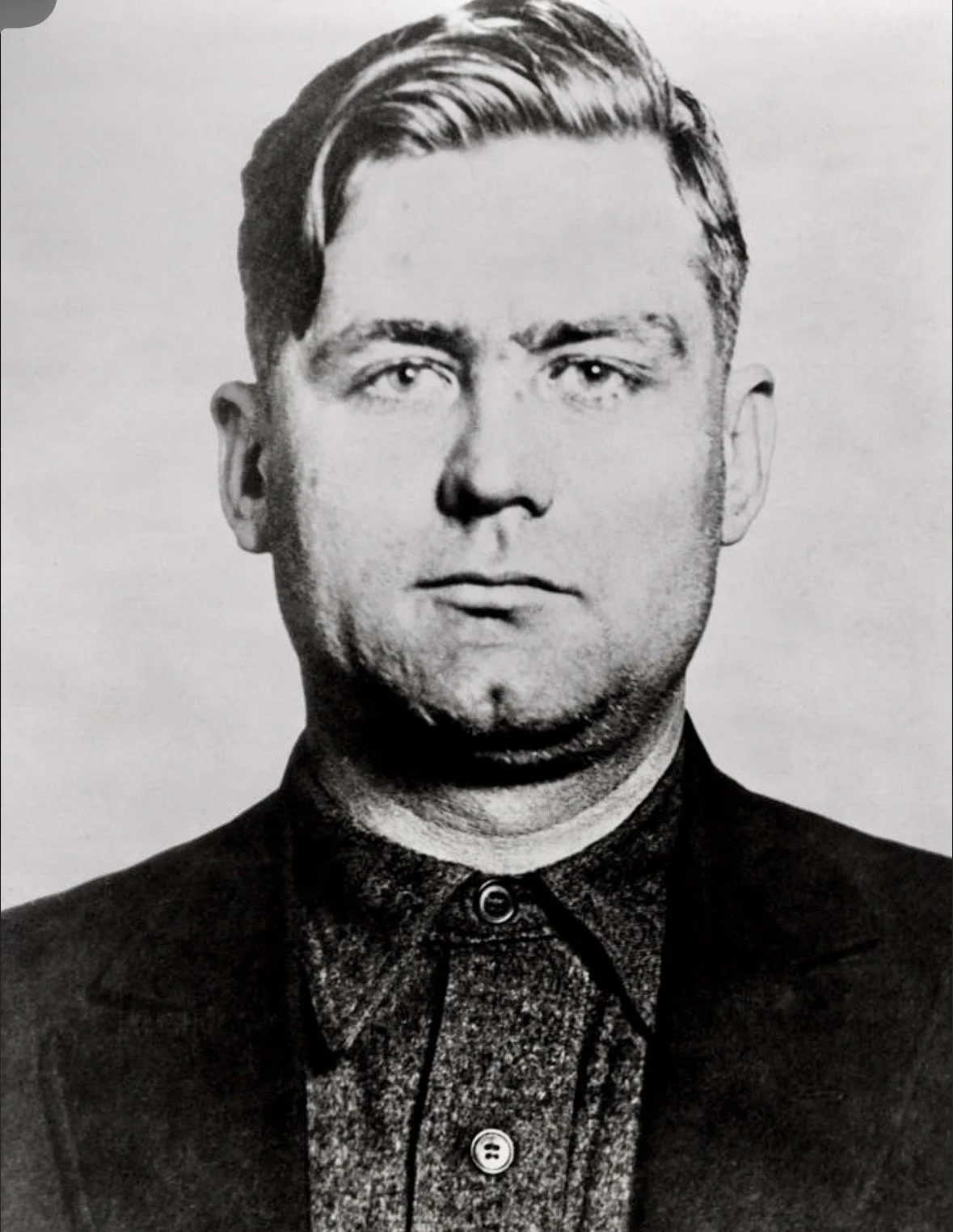
George “Bugs” Moran
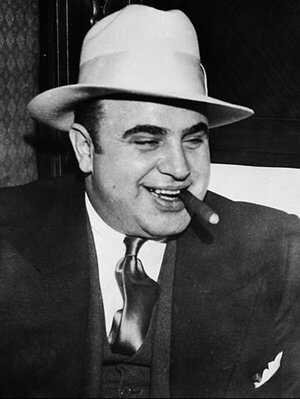
Al Capone
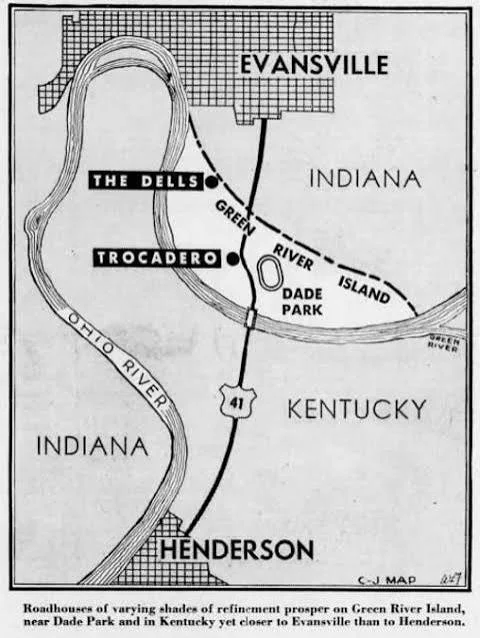
Map showing The Dells and The Trocadero
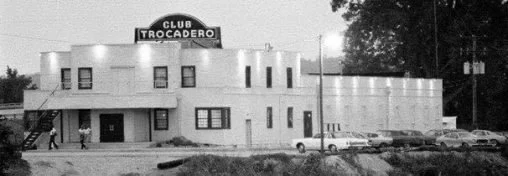
Club Trocadero
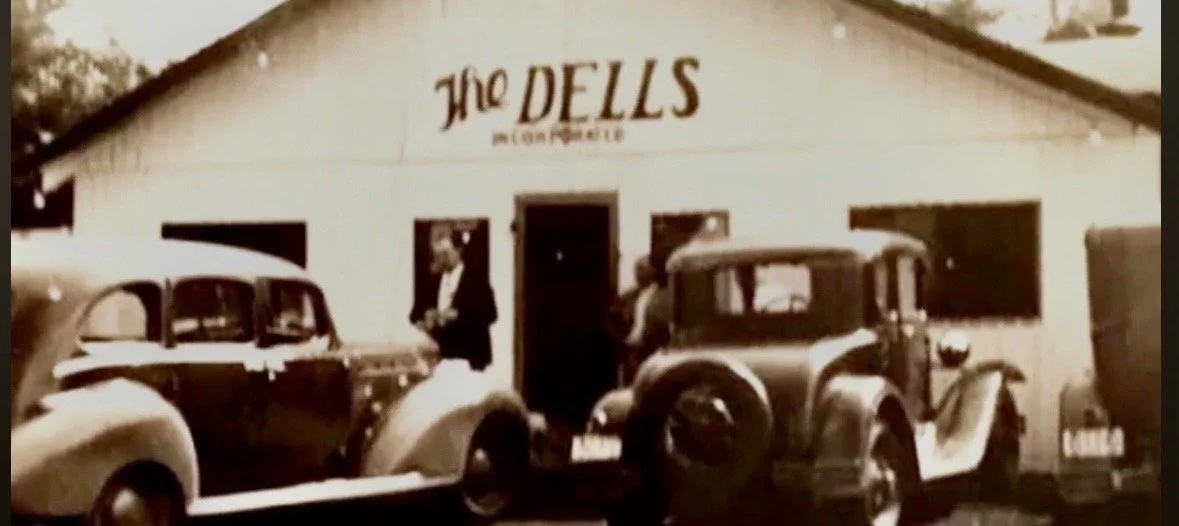
The Dells

The house on Center St. in Henderson where Bugs Moran was arrested.
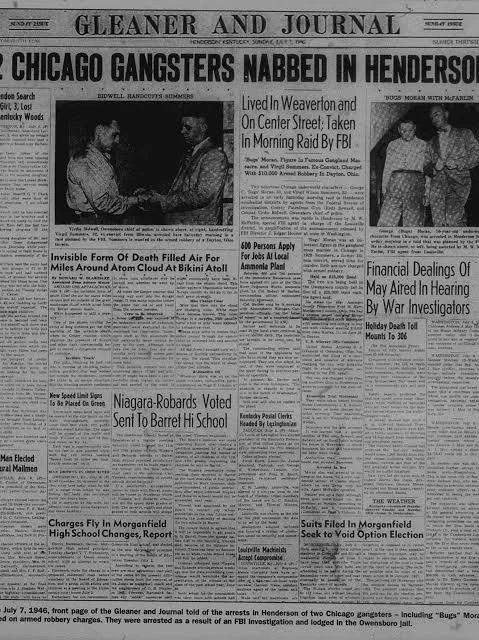
Front Page News Paper article about Morans Arrest
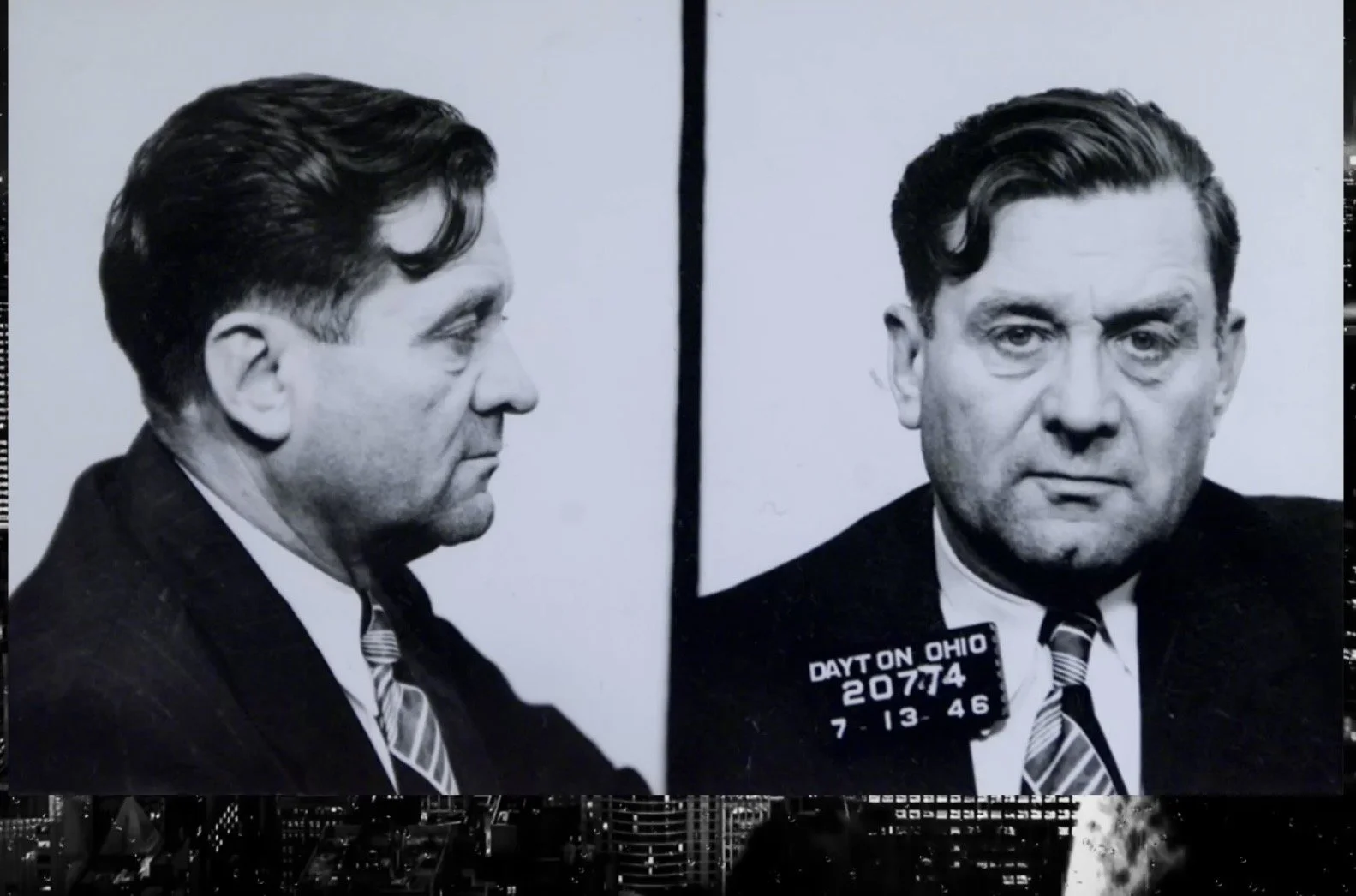
Bugs Moran mug shot after his Henderson arrest.
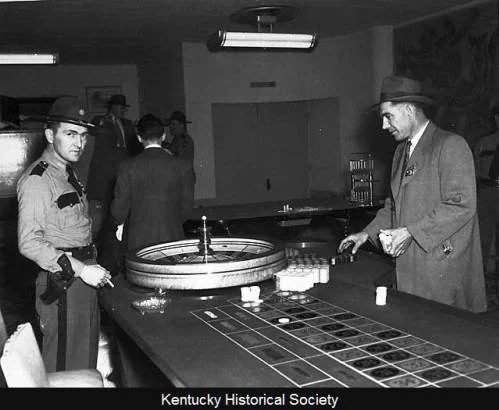
Henderson Gambling Raid,
Image provided by the Kentucky Historical Society