Blood on the Ohio, Sam Mason, the Harpe Brothers
Long before the Wild West became legend…
Before Jesse James…
Before Billy the Kid…
Before outlaws were turned into folk heroes…
There were men so feared that even murderers wanted nothing to do with them.
This is the story of Sam Mason… the Harpe Brothers… and the bloody frontier surrounding Red Banks—present-day Henderson, Kentucky.
It is one of the darkest chapters in early American history.
Near the end of the 1700s, Kentucky was still the frontier.
The Ohio River was America’s highway, carrying settlers, merchants, soldiers, and families into the unknown. Thick forests stretched for miles. Small settlements clung to the riverbanks. Law was scarce, and help could be days away.
It was the perfect place for outlaws.
One of the most notorious was Sam Mason.
Ironically, Mason wasn’t born a criminal.
During the Revolutionary War, he served the American cause and is widely believed to have been respected as a capable soldier. But after the war, something changed. Whether driven by greed, debt, opportunity, or simply the absence of law, Mason abandoned the life of a patriot and became one of America’s most feared river pirates.
For a time, he operated around Red Banks, the frontier settlement that would eventually become Henderson, Kentucky.
His gang robbed travelers moving along the Ohio River and nearby trails. As complaints mounted and authorities began paying closer attention, Mason’s growing reputation made it increasingly difficult to remain in Red Banks.
Eventually, local pressure forced him out.
Rather than disappear, Mason simply moved his operation to a secluded island in the Ohio River near Red Banks, where he continued robbing travelers. From there, he eventually relocated his headquarters to the infamous Cave-in-Rock, where his criminal empire reached its peak.
The massive cave opened directly onto the river, making it the perfect hideout.
Travelers floating downstream often believed they had found friendly faces offering food, shelter, gambling, or a safe place to spend the night. Instead, many found themselves robbed. Some simply vanished, never reaching their destination.
Then…
Things became even darker.
From Tennessee came two cousins who called themselves brothers.
Micajah “Big Harpe” Harpe…
and Wiley “Little Harpe” Harpe.
History remembers them simply as The Harpe Brothers.
Many historians consider them America’s first serial killers.
Unlike most frontier outlaws, the Harpes often seemed to kill for no practical reason at all. Robbery wasn’t always the motive. Sometimes cruelty itself appeared to be enough.
Victims included travelers…
Settlers…
Women…
Children…
Even people traveling with them.
Their reputation spread across the frontier faster than almost any outlaw before them.
Eventually, the Harpes found their way to Cave-in-Rock and Sam Mason’s gang.
But even hardened river pirates had limits.
According to numerous frontier accounts, the Harpes became so unpredictable and violent that Mason ordered them to leave his camp. Their senseless brutality threatened everyone around them and drew unwanted attention to Mason’s organization.
It’s an astonishing thought.
Sam Mason—a river pirate responsible for robberies and murder—considered the Harpes too dangerous.
Some historians have wondered whether Mason may have unknowingly pointed them back toward Red Banks. Having previously lived near Henderson, he certainly knew the region well. There is no proof he sent them there, but it remains an intriguing possibility.
Whatever the reason…
The Harpes soon arrived in Henderson County.
And tragedy followed.
One of the most heartbreaking stories connected to Henderson County tells of a local family.
While the husband was away, the Harpes reportedly came upon his cabin.
When he returned home…
He found his wife murdered.
His infant child murdered.
And a guest who had been staying with them murdered as well.
The loss devastated the community.
This was no longer just another outlaw story.
It had become personal.
The grieving husband gathered friends, neighbors, and frontiersmen into a posse determined to end the Harpes’ reign of terror once and for all.
They tracked the killers through the Kentucky wilderness.
When they finally caught up to them, the Harpes were reportedly in the process of attacking two campers.
Little Harpe escaped into the dense woods.
Big Harpe wasn’t so fortunate.
He was shot and mortally wounded before being captured alive.
What happened next blends documented history with one of Henderson’s oldest pieces of folklore.
Historical records confirm that Big Harpe was questioned before he died.
Local legend says the grieving husband—the same man whose family had been murdered—forced Harpe to confess to his crimes.
One by one…
Harpe allegedly described victim after victim.
The number climbed toward twenty.
Then, according to the legend, he calmly described how he had murdered the man’s own wife, infant child, and houseguest.
The confession was too much.
The husband ended Harpe’s life where he lay.
Big Harpe was decapitated.
His head was mounted on a wooden stake beside the road as a warning to every outlaw passing through the frontier.
The location became known as Harpe’s Head.
Remarkably, a historical marker still stands near Henderson today, preserving the memory of one of Kentucky’s most infamous frontier events.
Little Harpe vanished.
But his story wasn’t over.
Using an alias, he eventually made his way back into the outlaw world.
In one of history’s strangest twists, he found his way back to Sam Mason’s organization.
Whether Mason never recognized him or believed enough time had passed, Little Harpe was reportedly accepted back into the gang despite having previously been expelled.
His loyalty, however, lasted only as long as it benefited him.
The United States government had placed substantial rewards on notorious outlaws.
Little Harpe saw an opportunity.
When Sam Mason attempted to seek a presidential pardon by surrendering himself through legal channels, Little Harpe instead tried to murder Mason and collect the reward money for himself.
The plan failed.
Authorities quickly became suspicious of the men claiming the reward.
Despite using a false name, Little Harpe was recognized by people familiar with his reputation.
His true identity was uncovered.
Justice finally caught up with him.
Little Harpe was executed.
Like his cousin before him, he was decapitated.
His head, too, was displayed publicly as a warning to others.
In an extraordinary twist of history, both of America’s first notorious serial killers met nearly identical ends.
Today…
The forests have been cleared.
The settlements have become cities.
Families picnic where outlaws once hid.
Boats glide peacefully across the Ohio River where river pirates once waited for unsuspecting travelers.
Yet beneath Henderson’s quiet streets lies a remarkable history.
A Revolutionary War hero who became a pirate.
America’s first serial killers.
A grieving husband who helped end one of the frontier’s darkest chapters.
And two severed heads placed on stakes as warnings that justice—however harsh on the frontier—would eventually come.
The Ohio River has forgotten many stories.
This isn’t one of them.
Sources &Further ReadingKentucky Historical Society
Tennessee Historical Society
Local historical markers
Contemporary newspaper accounts
Books and archival records
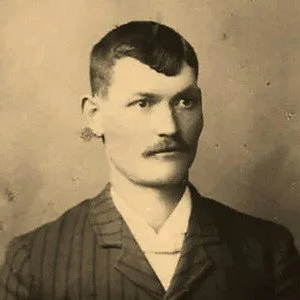
Captain Samuel Mason
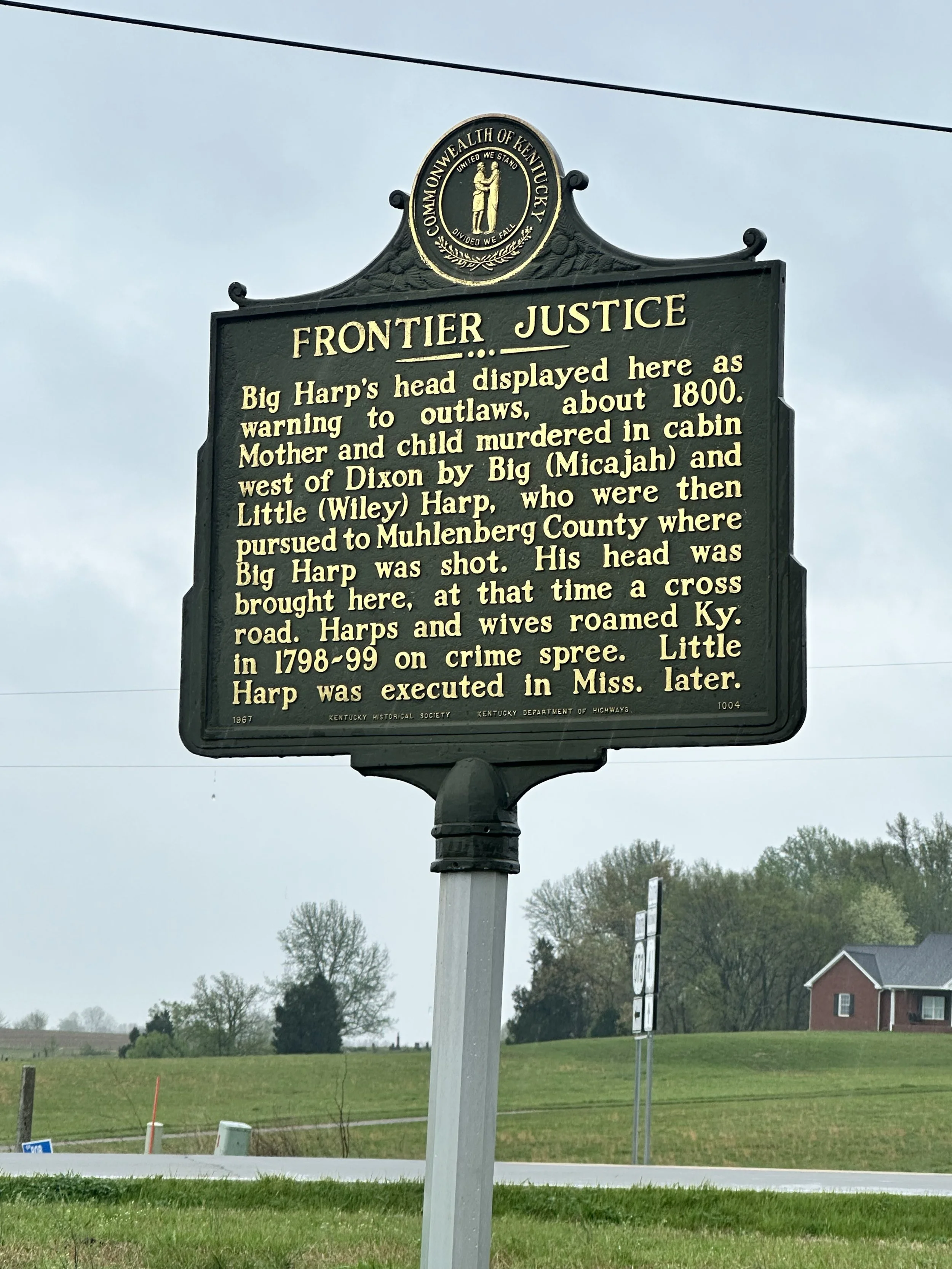
This sign still stands at the stop Big Harpes head was displayed as a warning to future travelers, criminals will not be tolerated in Red Banks(Henderson Kentucky)
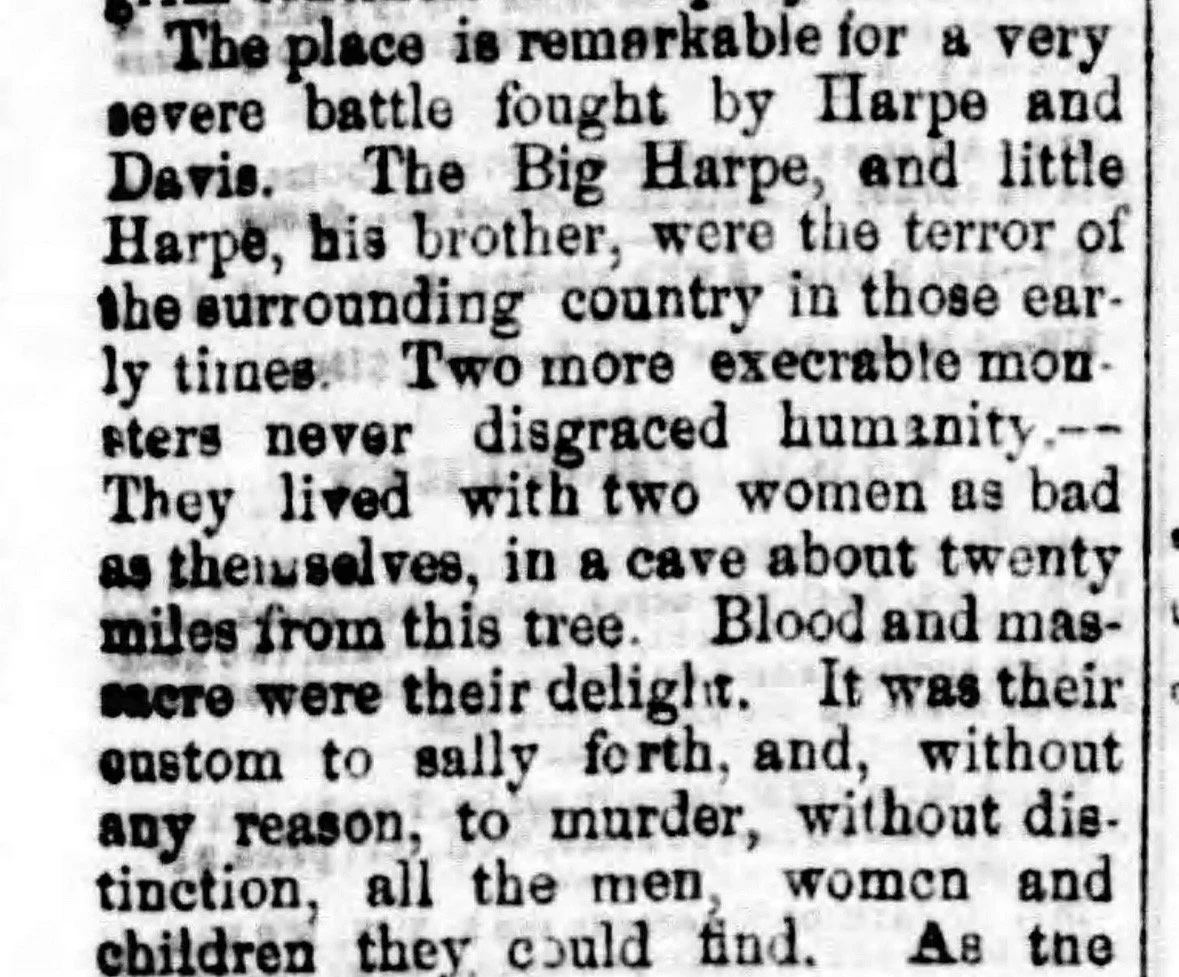
A portion of a 19th -century newspaper article describing the Harpe Brothers reign of terror.
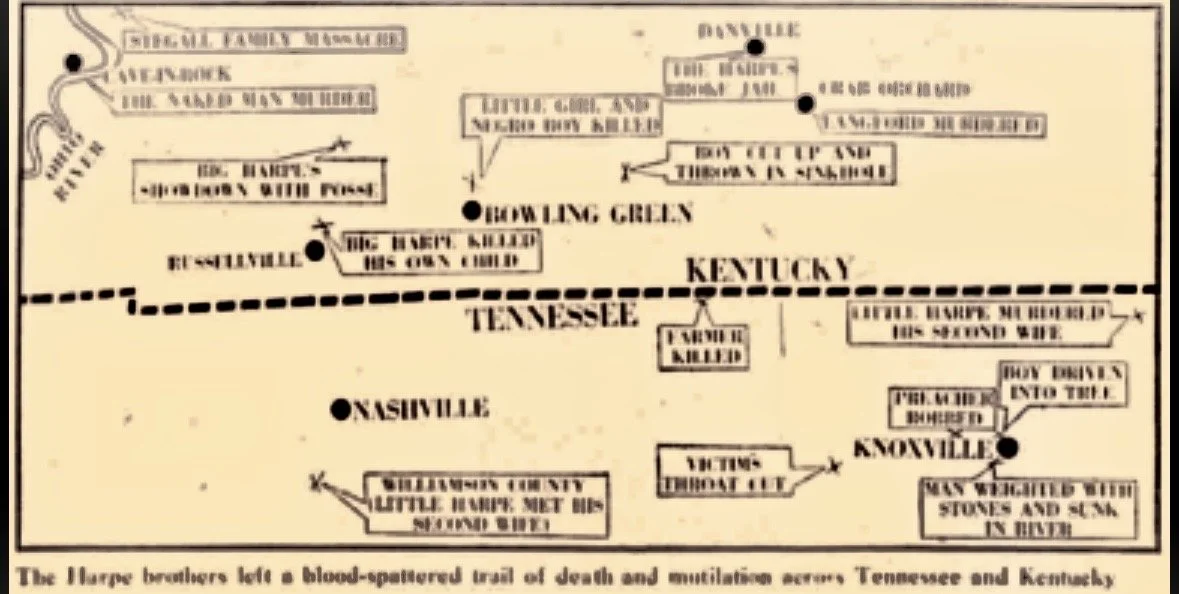
A map tracing the violence of the Harpe Brothers across Tennessee and Kentucky.
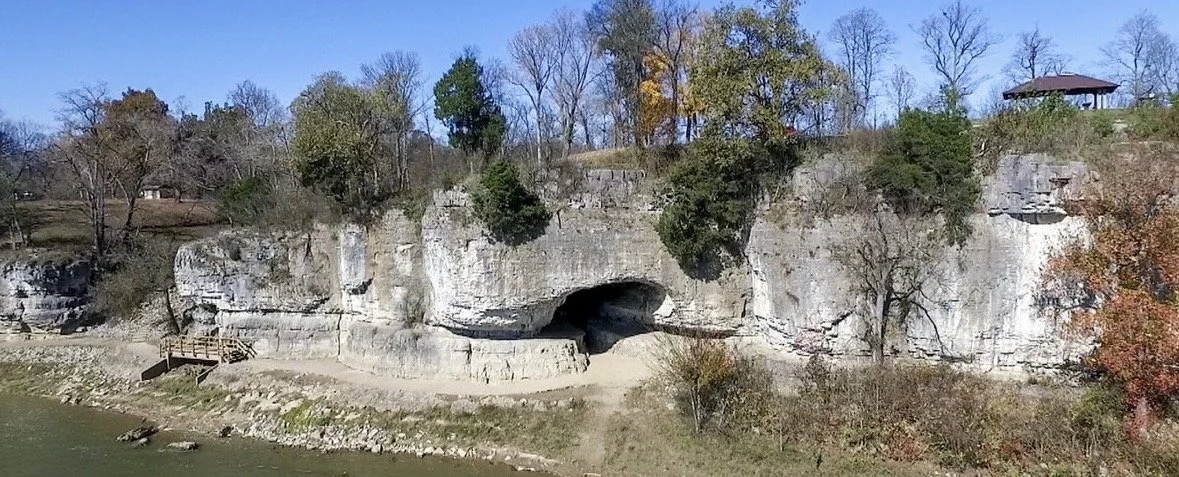
Above: The entrance to the famouse Cave-in-Rock on the Illinois side of the Ohio River.
Right: A view from the inside the cave looking out across the Ohio River.